


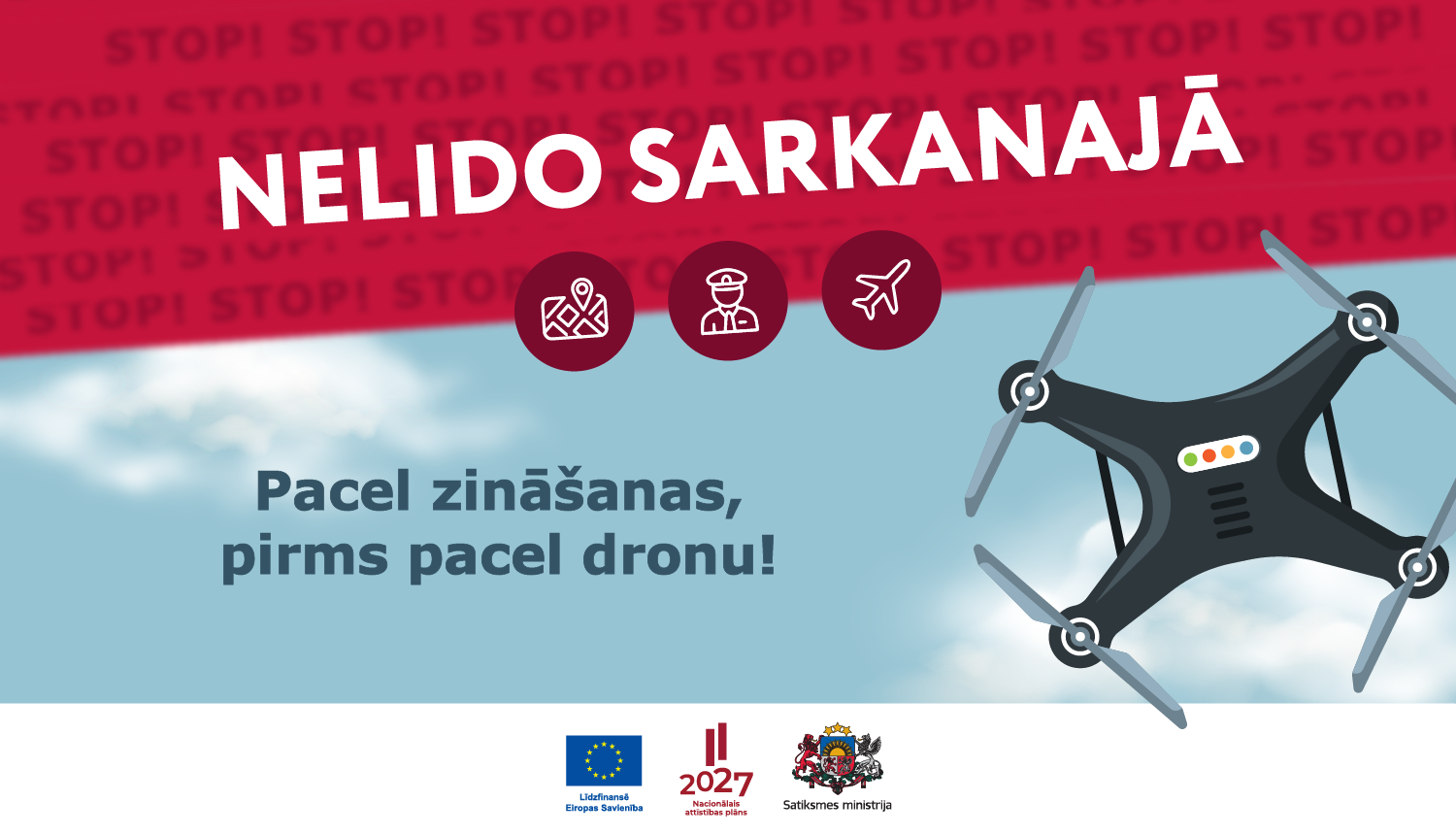
The Ministry of Transport, in cooperation with RIX Riga Airport and the state agency "Civil Aviation Agency" (CAA), is launching an information campaign, “Don’t Fly in the Red! Raise Your Knowledge Before You Raise Your Drone!” The aim of the campaign is to explain that unmanned aircraft – drones – are not allowed to fly in the vicinity of Riga Airport or other strategically important sites. Just like on the roads, there are also rules in the air that must be strictly observed so that drone flights are safe and do not cause incidents for other users of the airspace.
The campaign will run in the run-up to Christmas, reminding people that while drones are a great gift, they also come with extra responsibility.
“Drones are an increasingly popular holiday gift, but with the fun comes responsibility,” stresses Artūrs Kokars, Director of the Aviation Department at the Ministry of Transport. “Every drone user must know the basic rules, because most violations happen simply due to a lack of knowledge. Drone pilots need to keep in mind that the Riga Airport zone is not just the fenced airport area or its immediate surroundings. Flight restrictions also apply in the wider area around the airport, and the biggest problems are still in Imanta, Zolitūde and Āgenskalns, where people often don’t realise they are in a no-drone zone. That’s why our message is: first lift your knowledge, then lift your drone!”
The campaign targets all drone users, reminding them that there are rules that must be followed. The regulations clearly set out where and how you are allowed to fly, and in most cases users must register, label their drone and complete basic theoretical training. Before each flight, it is mandatory to check airspace restrictions – the UAS geographical zones map at airspace.lv/drones, as these restrictions can change several times a day. Flights in restricted zones must be coordinated in advance via the CAA Unmanned Aircraft Information System at e.caa.gov.lv.
Drone operators must be aware that Riga Airport operates a system for detecting, identifying and tracking drones, which records violations throughout the airport area. When a violation is detected, the operator can be identified and may receive a warning, a fine, or in serious cases even face criminal liability.
The area around RIX Riga Airport and other strategically important facilities is a special zone where drone flights are only permitted with prior authorisation. Unauthorised flights pose a direct risk to aircraft take-offs and landings, endanger air traffic, cause financial losses to the aviation sector and create serious inconvenience for passengers.
Both legal and natural persons who use drones must register and label their drones with the UAS operator number obtained during the registration process. When flying a drone, the operator must comply with altitude limits (up to 120 metres, unless different limits apply in a specific location), maintain visual line of sight between the remote pilot and the drone, and ensure a safe distance from people, animals and property.
Depending on the drone and the environment in which it is flown, the remote pilot must be able to present an appropriate certificate of competence. If the drone has a C1, C3 or C4 class marking, or if it weighs at least 250 grams, the pilot must first complete the CAA online training course and pass a theoretical exam before flying. The certificate obtained is valid for five years throughout the European Union. The CAA recommends that everyone take this free online course, as it helps to better understand the rules and the risks associated with drone operations.
If the planned flights fall into higher-risk categories, online training alone is not enough. In such cases, in-person exams must also be taken at the CAA or with CAA-approved training organisations.
Parents planning to give a drone as a gift to their children are encouraged to complete the online training together with them and to discuss restrictions and prohibited areas – the surroundings of airports, military and strategic sites, ports, high-voltage power lines and others. A clear understanding of the rules helps ensure that drones are used safely and responsibly.
The campaign will take place in the digital environment – on the social media channels of the Ministry of Transport and its partners – and will feature short educational videos on safe drone use, practical tips, and cooperation with content creators who will address young people and parents about responsible behaviour in the airspace.
The campaign is co-financed by European Union funds as part of the project “Implementation of a solution for the detection, identification, tracking and counteraction of unmanned aircraft” at RIX Riga Airport.
More information:
Training: droni.caa.gov.lv
Geographical zones map: airspace.lv/drones
Flight registration and coordination: e.caa.gov.lv
Communications Department
E-mail: komunikacijas@sam.gov.lv